
Three Things This Week
On Practicing Hope When Everything Feels Hopeless

The past few days have, once again, felt like standing in a river during a flash flood, watching the current pull everything loose downstream while you try to keep your footing. ICE raids across the country. People shot on video. Others rounded up at hospitals, schools, churches. And no matter where you stand politically, the images are hard to look at and should infuriate and petrify everyone.
Someone’s always getting hurt. Someone’s always terrified. And we’re all just scrolling through it, holding our phones like they might explain how we got here.
I don’t have all the answers, I’m still trying to figure it out. But I know this much: when the ground beneath you starts to shake, you have to first find your balance before you can move forward. And move forward you must.
So this week, three things that might help us do that.
Something to Learn: What Thích Nhất Hạnh Taught Martin Luther King
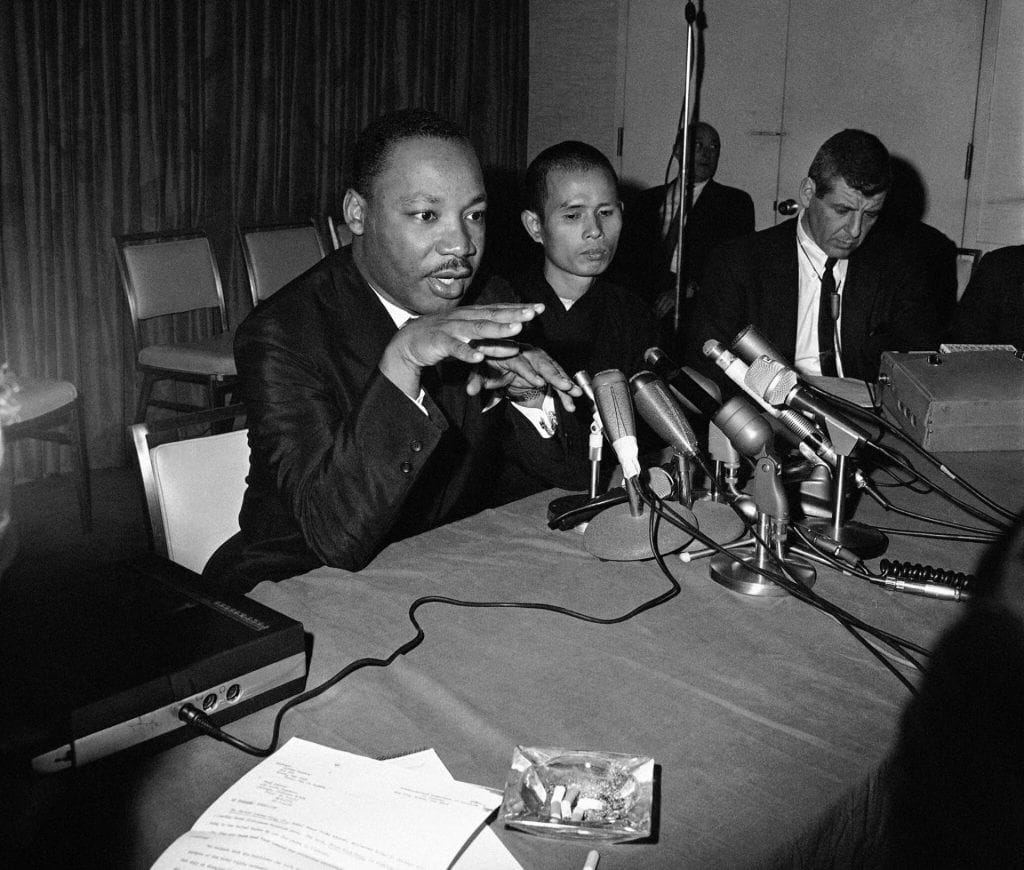
In 1966, Thích Nhất Hạnh traveled from Vietnam to the United States. His country was being destroyed. Villages burning. Children running through napalm clouds. He came to speak about the war, but more importantly, to speak about peace as a way of being.
Martin Luther King Jr. heard him speak at a conference in Chicago. They met briefly, but the encounter left a mark. The following year, King nominated Thích Nhất Hạnh for the Nobel Peace Prize. In his nomination letter, King wrote that this monk “speaks with the voice of the Vietnamese people.” But what moved King most was Thich Nhất Hạnh’s teaching that peace work requires inner transformation, not just political action.
Think about the context. Both men were watching their worlds fall apart. King was facing death threats daily, losing allies, watching the movement fracture. Nhất Hạnh’s monasteries were being bombed, his students killed. They had every reason to despair. Every reason to give up or give in to rage.
But they didn’t.
The teaching Nhất Hạnh gave King, and gives us now, is this: hope is not a feeling. It’s a practice.
In Buddhist terms, this comes from the understanding of impermanence. Everything changes. Always. The suffering you’re witnessing right now? It will change. The structures causing harm? They will shift. Nothing, no matter how solid it appears, stays the same.
But impermanence cuts both ways. Just as injustice can deepen, it can also dissolve. Just as darkness can spread, light can break through. The question isn’t whether change will happen. The question is: what are we doing to shape what comes next?
Nhất Hạnh showed King that hopelessness is actually a form of arrogance. It’s the belief that you can predict the future, that you know how the story ends. But you and I don’t. None of us do. King said it himself: “The arc of the moral universe is long, but it bends toward justice.” The key word there is long. Not immediate. Maybe not even guaranteed in your lifetime. But moving.
Here’s how this becomes a practice. When everything feels hopeless, like it kinda does now. When you’re drowning in news of another senseless death and separations and cruelty, you come back to one question: what is mine to do right now?
Not what can you fix. Not how can you save everyone. But what small, specific action can you take today that moves in the direction of your values?
For Nhất Hạnh, during the war, it was teaching one group of young monks how to rebuild villages. For King, in his darkest moments, it was writing one letter, making one speech, showing up for one march. They didn’t wait to feel hopeful, they acted, and the action created its own momentum.
Nhất Hạnh called this “being peace.” Not waiting for peace to arrive, but embodying it in how you move through the world. In how you speak to the grocery store clerk. In how you breathe when the news feels unbearable. In how you show up for one person, one moment, one decision at a time.
In a letter to King, Nhất Hạnh wrote: “I am sure that since we all light our torch from the same flame, we can understand each other very well.”
Same flame. Different torches.
That’s the teaching. Even in the darkest times, the flame doesn’t go out. It gets passed. Person to person. Act to act. You don’t need to see the whole path illuminated. You just need to hold your torch steady and trust that others are doing the same.
Right now, with ICE raids and families torn apart and the ground shifting beneath us, it’s tempting to believe nothing matters. That it’s all too big, too broken, too far gone. But Nhất Hạnh and King both lived through worse and they kept going. Not because they were superhuman. Because they understood something essential: perseverance isn’t about feeling strong. It’s about showing up anyway.
You practice hope the same way you practice meditation. You sit down even when your mind is chaos. You return to the breath even when it feels pointless. You show up even when you can’t see the results.
Because hope isn’t about certainty. It’s about commitment. To keep your torch lit. To pass it on when you can. To trust that the flame, however small, still matters in the dark.
Something to Practice: Regulate First, Respond Second
I know, I know. I’ve been critical of the “nervous system regulation” trend that’s taken over wellness culture. The constant focus on polyvagal theory as if all of life’s problems can be solved with a few deep breaths. But the reality is when your body is flooded with stress hormones, when your sympathetic nervous system is screaming danger at full volume, you can’t think straight. You can’t make decisions. You can only react.
And reaction, in moments like these, can be dangerous.
So before you post that angry comment, before you cut off your uncle at dinner, before you make any big decisions about what you’re going to do or say or fight for, pause. Give your body a chance to come down from the ledge. Regulate then respond.
Here’s what actually works:
Box breathing. Four counts in. Hold for four. Four counts out. Hold for four. Do this for two minutes. It activates your parasympathetic nervous system, the brake pedal. Research from Stanford shows this pattern specifically reduces cortisol and brings heart rate variability back into balance.
Orient to your environment. Look around the room. Name five things you can see. Three you can hear. One you can touch. This pulls you out of threat detection mode and into present awareness. Your nervous system needs proof that right now, in this moment, you’re safe.
Move. Walk. Shake your hands. Roll your shoulders. Trauma gets trapped in the body. Movement helps complete the stress cycle. You don’t need a fancy somatic practice. Just move.
A lot of us are angry and outraged right now. It’s okay to be. This isn’t fair, and your body knows it.
Once you’ve regulated, once you’ve brought yourself back online, then you can strategize. Then you can figure out what action you have capacity for. Whether that’s showing up at a protest, making calls, donating, having hard conversations, or simply holding space for someone who’s scared. All of it matters. But none of it works if you’re running on fumes and adrenaline.
Something to Enjoy: Time Off the Phone, Time With Each Other
The phone right now is a strange cocktail: dopamine hits mixed with trauma footage. Updates that feel urgent and outrage that feels righteous. And underneath it all, the algorithm learning exactly which combination of horror and hope keeps you and I scrolling.
Put it down.
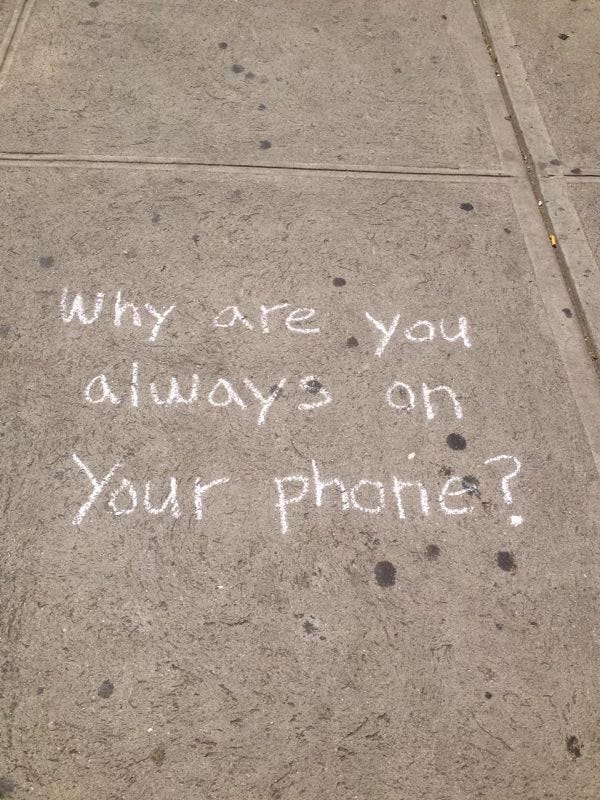
Not forever, not as spiritual bypass. But as a practice. Reclaim your attention from a device designed to fragment it and redirect it toward the people who are actually in front of you.
Go for a walk with someone. Sit across the table and just talk. Make eye contact. Listen without thinking about your response. Let the conversation wander. Let it be messy and human and slow.
The phone might give us the illusion of feeling connected, but it doesn’t make us present. It creates a sense of proximity to everyone while keeping us distant from the person sitting next to us. And in times of upheaval, real connection, the kind that happens face to face, voice to voice, is what actually saves us.
We need each other right now, more than ever. Not just our Instagram stories or tweets. Each other. We need to feel each other in yoga classes, in subways, at churches or over coffee.
Gather people around your table. Create moments where phones go in another room and you just exist together. Talk about what’s happening. Or don’t. Sometimes just being in the same space is enough.
Maybe you’ll remember that you’re not alone in this. That connection isn’t something that happens through a screen. It’s what happens when we look up and see each other clearly. Afraid. Angry. Uncertain. But here, still.
And, I don’t know. Maybe that’s enough to keep the flame lit.
hope is not a feeling. It’s a practice. I needed to hear that today, thank you.
beautifully written Manoj